Religions are almost always passed down through families, actively constructing an individual's worldview from the very initial stages of childhood. Religious beliefs serve as the fundamental lens through which an individual understands the world around them. Because religion plays a huge role in setting the boundary of an individual's empathy, it dictates what we label as moral, and how we measure the worth of our fellow human beings and other life forms in general. Long before any formal education, religious heritage governs how an individual looks at others and decides whether to see a friend, a blank slate, or a threat. From our deepest fears to our highest ideals, these inherited belief systems shapes our society and culture. Religions possess a unique power to either expand human empathy to a global scale or contract it into a narrow, defensive silo. To understand the impact of religions on diverse societies — how it fractures, or flourishes — we must first acknowledge the profound, invisible grip that religious conviction holds over the individual mind.
To understand how different belief systems can construct distinct mindsets for individuals depending on their religion, we must divide religion into two distinct categories: Polytheism and Monotheism. Because Polytheistic traditions recognize a plurality of deities, these faiths do not claim a single monopoly on the divine, making them naturally accommodating. In a polytheistic worldview, discovering a neighbor who worships different gods is not viewed as a spiritual threat, but simply as a reflection of the world's natural diversity; it is merely another way of interacting with the sacred. Consequently, history shows that purely polytheistic religions rarely, if ever, created systematic religious extremism or launched dogmatic wars of forced conversion. Lacking the rigid "only our belief is the right belief" dogma that creates "us versus them" dynamics, polytheism allows diverse communities to look at each other’s customs not with existential hostility, but with a flexibility, and sometimes even an acceptance of foreign rituals as an extension of their own.
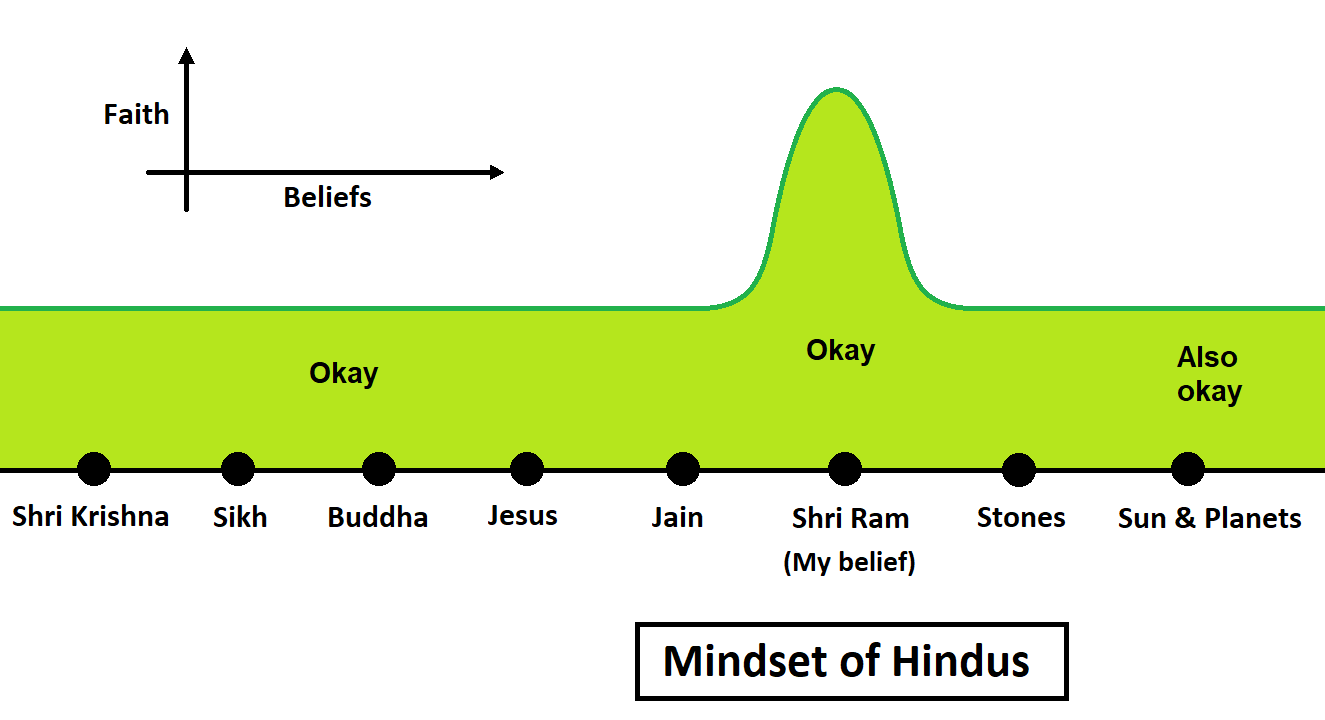
For example, Hinduism historically accommodates everyone — from the deeply theistic to the explicitly atheistic. Hindus largely believe that God is in every bit of the universe, meaning God can exist without form or manifest in any form imaginable. This foundational philosophy fosters a diverse set of beliefs and practices within Hinduism. Because of this acceptance of diversity, an outsider is not viewed as an enemy, but rather as just a different expression of the same ultimate truth. This welcoming mindset is uniquely possible in a polytheistic religion like Hinduism, which gives individuals the freedom of choice in their religion. This freedom is the foundation and essence of Hinduism, making it a 'Religion of Freedom' in its truest sense.
On the other hand, Monotheistic religions operate on a completely opposite psychological and structural blueprint. By definition, they compress the infinite expressions of the divine into a single, supreme deity who demands absolute, exclusive devotion. In Monotheistic framework, truth ceases to be a vast, multi-faceted reality and becomes a singular, narrow path confined within a fraction of the actual reality. This shift from "many" to "one" fundamentally transforms how an individual views the world, replacing tolerance and acceptance with a rigid binary where only one scripture is holy, only one prophet is true, and only one way of living is pleasing to God. Consequently, personal freedom of choice is completely stripped away, leaving individuals with no option but to conform under a strict moral obligation. Those who choose a different path are labeled as disbelievers and are frequently viewed as enemies. Historically, this rigidity in monotheism has resulted in severe persecution, forced conversions, and radical religious extremism. By claiming a strict monopoly on divinity, monotheism inherently turns differences into deviations, transforming political or social disagreements into "us versus them" holy wars.
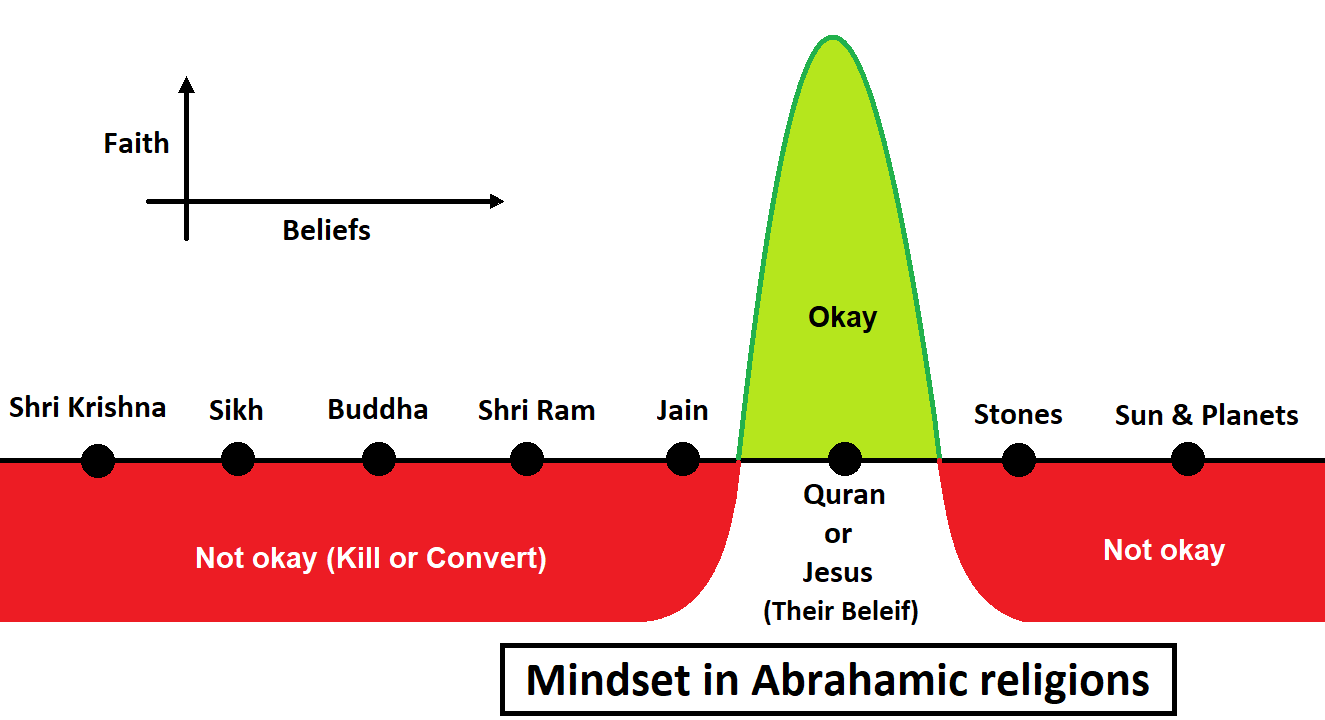
Abrahamic religions like Islam, Christianity and Judaism are fundamentally monotheistic, operating on the premise that only one belief system is the absolute truth and all other beliefs are entirely false. Consequently, within the Abrahamic framework, the whole of humanity is divided into a strict binary: believers and non-believers. This worldview naturally creates a tendency among followers to diminish, convert, or destroy the religions, rituals and traditions which they consider false. Because monotheistic belief systems do not inherently embrace or tolerate freedom of belief, they inevitably fracture the social fabric of a diverse society. In their strict orthodox interpretations, non-believers — labeled as Kafirs or Infidels — are viewed through a lens of enmity. By transforming simple cultural differences into an existential battle between absolute truth and absolute falsehood, and this is the exclusive mindset that inevitably drives diverse societies toward radicalization and violence.

Monotheistic religions shouldn't be allowed to get mixed with any different monotheistic or polytheistic society. When an exclusive theological framework encounters a culturally distinct or pluralistic society, it frequently triggers deep socio-political destabilization. Few examples-
1. Unrest in Europe: Several European nations have experienced socio-cultural issues after accepting Muslim immigrants.
2. Persecution of Hindus in Pakistan and Bangladesh: Institutional and societal devotion to an exclusive monotheistic state identity has systematically marginalized indigenous populations, resulting in the continuous persecution, forced conversion, and demographic erasure of local Hindu communities.
3. The Islamic Conquest of Persia (Modern day Iran): The native Zoroastrian population faced systemic subjugation, heavy taxation (jizya), and forced conversion in 7th century. Forcing Parsis to flee to India to save their lives and ancestral heritage.
4. Mass conversion in Africa: Over the last several decades, well-funded Christian missionary campaigns in nations like Nigeria, the Democratic Republic of Congo, and Ethiopia have systematically eroded traditional, indigenous pluralistic belief systems. By introducing an exclusive monotheistic Christian religion, which creates "us versus them" dynamics in a diverse society, they have fractured the tribal cohesion and ignited deep internal communal conflicts that persist even today.
Ultimately, the historical data reveals a fundamental asymmetry in how different religions impact global demography and governance. Dozens of Muslim and Christian countries already exist in this world—many of which legally restrict minority rights. This is living proof that monotheistic belief systems struggle to accept diversity. On the contrary, there are more than a billion Hindus, but there is not a single Hindu country in this world. The polytheistic Hindu religion tend to accept different belief systems and can easily coexist with others, and that’s the major difference in mindset, which separates Polytheism from Monotheism. However, the acceptance of diversity in Hinduism comes with a heavy cost. Hindus historically struggle to unite under a single banner to defend themselves. Thus, ironically, the very feature that makes Hinduism great for a diverse society becomes its weakness.
Don’t get me wrong; I don’t hate Christianity, Islam or any other monotheistic religion. But the structural nature of monotheism is such that it requires only its own separate space to exist peacefully without posing threat to others. From the security point of view, every faith—including polytheistic traditions—need its own sovereign state to protect itself. Otherwise, in any Secular country, the Monotheistic mindset of ‘My belief is right, and your belief is wrong’, will inevitably erode the country from inside out. Look at it like a chemistry lab, it would be absolutely foolish to throw all kinds of highly reactive chemicals into a single container and expect them to coexist peacefully— ‘multi-chemicalism’, right? I know that humans are conscious and chemicals are not, but are all human beings conscious enough to avoid conflict? Definitely not, and often it takes only few radical individuals to trigger a major conflict. Hence, just like chemicals, every religion has its own distinct properties, and they must be kept separately for the safety of their people and to maintain a stable harmonious culture. That is precisely why nations should have state religion.
Furthermore, the world is more interesting and beautiful when it is globally diverse, not when every individual country looks exactly the same. if every place becomes equally diverse everywhere, the joy of travel and cultural discovery would not make sense. The fact is, in the name of ‘Secularism’, we have forced everyone into the same space just to tolerate each other, and that creates an ugly, fragile society. Let your country be what it was truly meant to be. Do not let your homeland be hijacked by the impractical utopian ideas like secularism and multiculturalism, which have clearly failed humanity. When boundary collapse, countries die from outside. When cultural identity fades away, nations die from inside. Saving your nation is your responsibility. Yes, yours! Whether you are a citizen or a politician. Wake up!
For my own country, Bhaarat, I want a Hindu nation. By the same logic, Europe and the United States should remain Christian, and the Middle East should remain Islamic. Just as the Jews and Muslims have already established their own nations in the Middle East, all the Christians in USA and especially in Europe, need to demand that their governments officially declare their countries as Christian nations. Christians in Europe are really in deep trouble right now. People in the West, need to share this using #Nation4Christian in social media. Similarly, all Hindus in Bhaarat must demand that our government declare Bhaarat a Hindu nation, and remove the word 'Secular' from our constitution. Hindus have already been the target of religious extremism for far too long in the Indian subcontinent. Indians need to share this using #Rashtra4Hindu in social media. There should be no conquest, no foreign interference to spark conflict—just peaceful coexistence, achieved by maintaining a safe, separate space for every religion, tradition and culture to thrive.