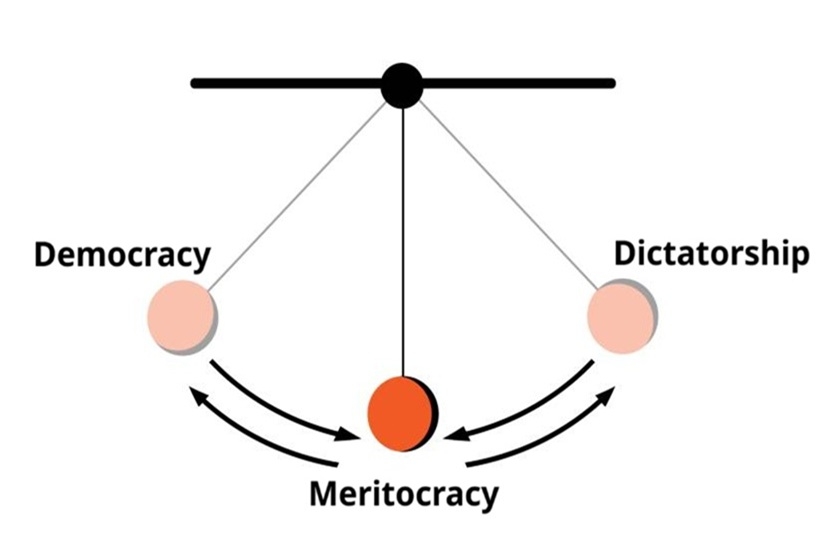
Democracy is the opposite extreme of Dictatorship. From only one person holding all the power, to everyone having a tiny piece of it. While Dictatorship brings tyranny, Democracy brings chaos. In dictatorship, only one is responsible; in democracy, no one seems responsible and people feel completely lost in a bureaucratic jungle. The journey from Dictatorship to Democracy is like pendulum swinging from one unstable extreme to another. Democracy is not the gold standard of political systems; rather, it was born simply as a reaction to tyranny in a dictatorship. What we actually need is a stable system where only deserving and competent people can earn the power to run the country efficiently — and that system is Meritocracy.
In a democracy, people who run the government have to get elected by the people of the country. But elections create some major issues. The most concerning issue is that the only those candidates who can invest large sums of money into a political campaign, can win elections. This includes bribing voters - either legally through government schemes or illegally in the background. Winning under these conditions forces the winning candidates to engage in massive corruption later, simply to recover their invested amount with some profits. This structural flaw means the democratic system is bound to produce corrupt politicians. Because elections are extremely expensive, ordinary people just can't take this risk to run for an office. Expensive election system practically locks the political power behind a paywall, that is only accessible to the rich people. Democracy has successfully built an illusion of equality, but in reality, it is a playground for the rich — an oligarchy in disguise, and it has failed to establish a level playing field for everyone.
Another major issue that people usually fail to notice is that any candidate can win elections simply by hiding behind the face of their party leaders. It's like a student passing an exam using their friend's scores. This is pure cheating, but the election system allows corrupt people to win elections under the camouflage of a popular leader or a big political party. Because of this loophole, widespread corruption becomes an obvious and inevitable consequence of the democratic systems.
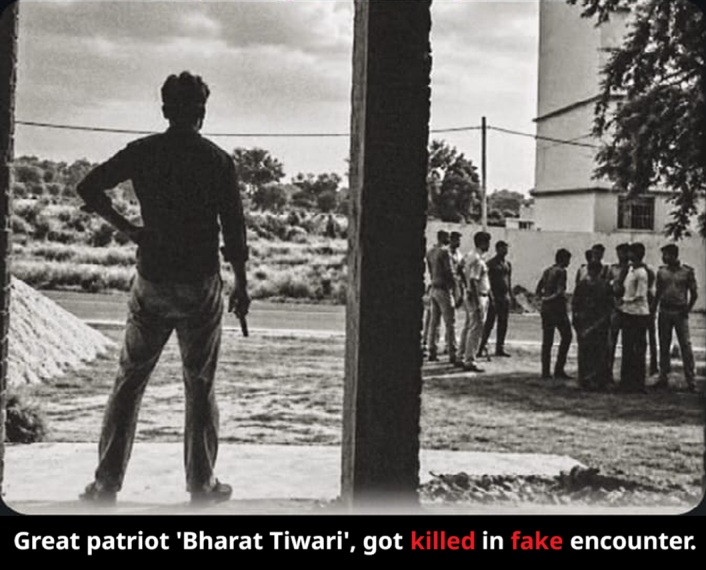
Also, after investing so much money to win such a costly election, if any citizen expects politicians to work honestly, then that citizen instantly becomes a target. Corrupt politicians do not want anyone standing in their way, after investing so heavily to get elected, and they will not hesitate to abuse government machinery to eliminate anyone who threatens their corrupt income streams. Thus, in a democratic system, the most honest and deeply committed social activists are bound to get targeted or even killed. No wonder we have lost so many honest, hardworking social workers, brave news reporters and countless other activists. It's a systemic failure, and only democracy is to blame.
Democracy is a system where popularity is rewarded over wisdom and competence. Thus, to influence as many voters as possible, leaders waste their own money and taxpayers' money on excessive advertisements. Public image is much more important in elections than actual public service, and thus deception becomes the main strategy by which candidates can win elections. It's not like our country does not have honest and deserving candidates for the positions of political power, but the election system ensures that only deceptive people get chosen and rewarded. The election system simply filters out the honest candidates. No wonder, Leaders who lie, deceive and manipulate voters are practically the only ones who can win elections. Choosing honest leaders through elections is like trying to collect water with a sieve — it is simply the wrong tool for the job. Ultimately, Democracy is a failed system; it is similar to an old broken engine, that devours money and creates too much noise, yet leaves its citizens completely stranded.
I have learnt these lessons firsthand when I personally ran for MLA in assembly elections and witnessed closely how broken, corrupt and resource-hungry this whole democratic system truly is. Even the voters (here in India) openly demand bribes (cash or alcohol) just to give you their vote. This experience proved a harsh reality - It is not that the elected politicians become corrupt; the fact is, only the corrupt ones can get elected. As an honest candidate, democracy simply filtered me out. Democracy is just Mobocracy in disguise. The political system of any nation must be designed around its citizens. Democracy is not a universal answer for every country around the world. 'One size does NOT fit all', and for Bhaarat, democracy is just an ugly hopeless joke.
Dictatorship is the competition of physical power, which leads to violence. Democracy is the competition of influence, which leads to systemic betrayal through widespread propaganda and deceptive manipulation. What we actually need is a competition of intelligence and promotion based on a track record of integrity, which can lead us to prosperity. Our democratic system is divided into a ruling party and an opposition, and this inherent divide forces politicians to constantly fight each other for short-term petty political gains, rather than working collectively for the whole nation. To eliminate this endless division and meaningless quarreling, we desperately need a unified, meritocratic political structure that allows deserving people to lead. We need a system where honest people even from humble backgrounds can work their way up to the highest positions of government based on their performance, and where leaders can focus entirely on the country's progress and citizens' well-being.
The idea is to eliminate the election system entirely and introduce a national-level entrance exam to enter politics. This computer-based exam would test relevant, real-world subjects, including: Law & Civics, Applied Economics, Physics and Mathematics, Philosophy and Ethics, Crisis Management & Disaster Response, and Sociology. To respect local cultures and eliminate language barriers, all the qualified top-ranking candidates would be eligible to start within their own home states at the bottom of the political hierarchy as Ward Members. Future promotions or demotions would be based strictly on individual performance, creating a corporate-like structure with no opposition. One-way communication in the current democratic government is the foundation on which corruption and tyranny thrive. Thus, under this new system, citizens would have a single, direct point of contact with the government: their highly qualified Ward Members.
To make governance effortless, a simple, public, text-based social-media-like platform should be launched. Citizens would be able to message or create a public post specifically for their local Ward Member, ensuring no single official is overwhelmed with complaints and enquiries. The Ward Member would be required to reply within 24 hours. If they fail, citizens will have the option to contact higher authorities directly. This system will provide immediate relief to the public from the bureaucratic jungle, while creating a permanent, digital history of public grievances and official responses — making it incredibly easy to evaluate a leader's performance. This transparent two-way communication is essential for a healthy, responsive government. With this streamlined citizen-government communication, public grievances can be resolved rapidly, constitutional amendments and new legislation can be introduced and implemented to make the governance more useful and efficient as it matures. Getting assistance from the government will become significantly easier. Furthermore, it will create millions of administrative and technical jobs for our highly educated youth, and our country has enough budget to fund the salaries of all the new qualified Ward Members. This two-way communication would stand as a shield against tyranny, a cure for chaos, and an efficient engine built to serve the common citizen. This is the foundational blueprint of a truly responsive and citizen-centric political structure. While a system like this could be described as a 'Dialecto-Meritocracy', let us simply call it a Meritocracy for now. Also, it would be pointless to discuss further details about this hypothetical framework unless we have a practical way to actually implement it.
Democracy has problems, and I have a vision for a better political structure. We desperately need a systemic upgrade—not just a swapping of political parties, but the replacement of the entire political structure. It’s about time we uproot the old, sluggish, corrupt democracy and establish a new, responsive, meritocratic political system. We need to raise widespread awareness about these critical flaws of democracy, gather massive public support, and make this change a reality.